

On Wednesday, August 26, we hosted our webinar "How to Retain More Members and Grow Profitably with AI-Powered Retention Intelligence," and it was a full room. Gym owners, boutique studio operators, wellness centre leaders and independent practitioners from across Canada joined us for an hour, and Zach Weston, Executive Director of the Fitness Industry Council of Canada, was among the attendees. FitBizWeekly had covered the session ahead of time, and the question they framed is the one we set out to answer: can AI help you spot member disengagement before it turns into a cancellation?
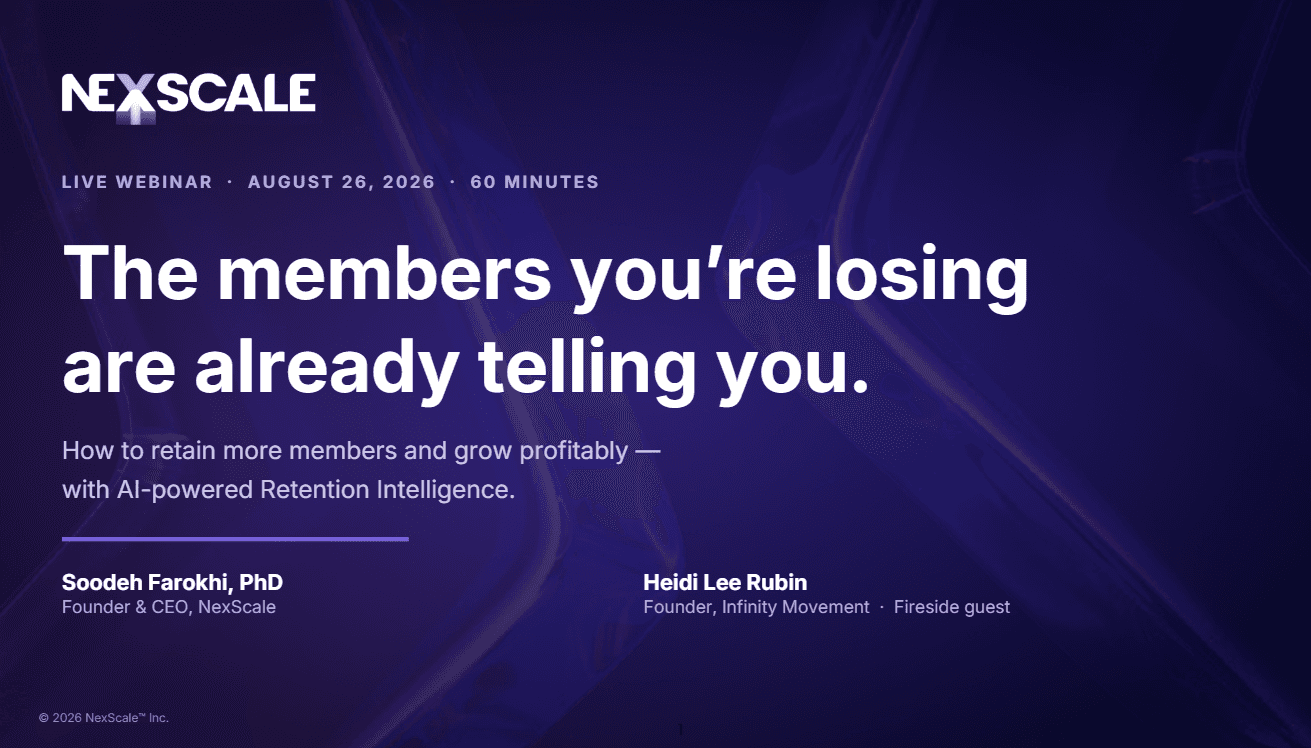
If you could not make it live, the full recording is available on request (details just below). If you prefer to read, this post walks through everything we covered, including the part most people told us they came for: the unscripted fireside chat with Heidi Rubin, founder of Infinity Movement in Montreal and one of our Founding Operators.
Want the recording? 60 minutes, including the unscripted fireside chat with Heidi. Request it here and we will send it to your inbox.
Who was in the room
When people registered, we asked two questions. The first was "What is your top barrier to scaling?" Member retention came out as the number one answer, ahead of getting new members. The second was "What are you hoping to get today?" The top answers were "see how it works" and "retention tactics."
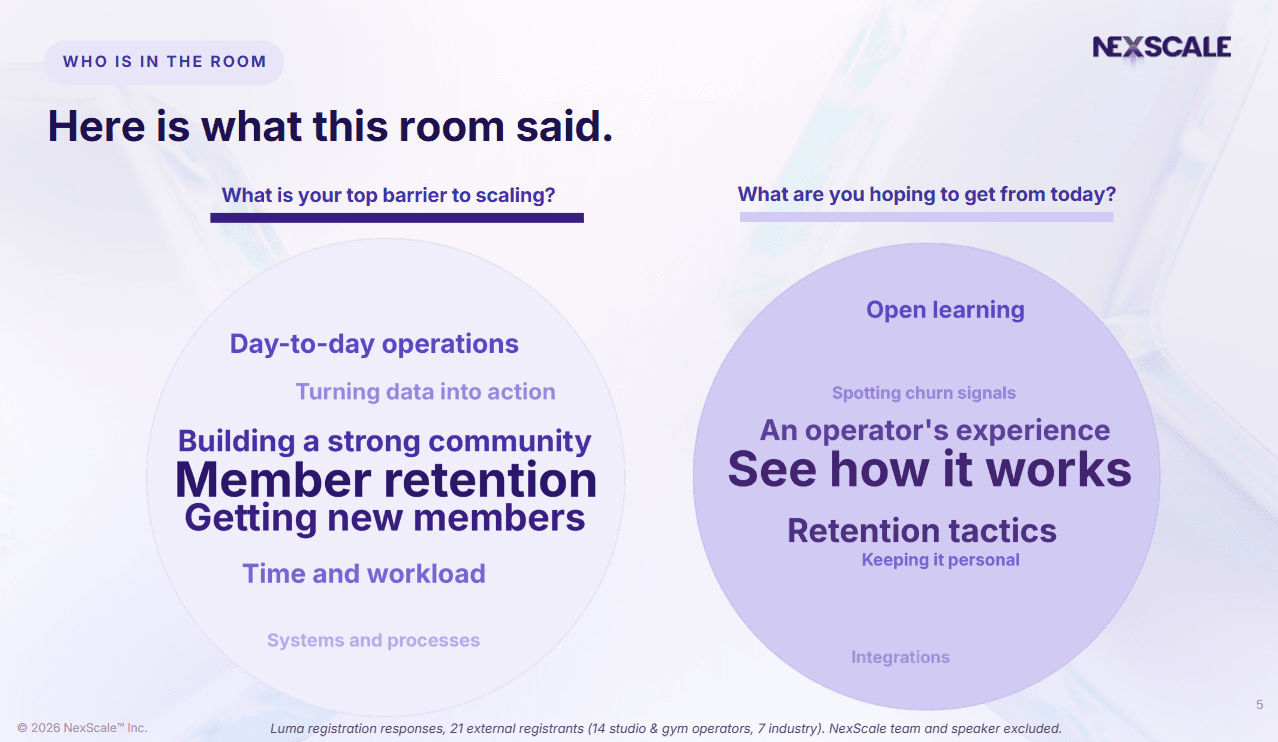
That shaped the hour. We built the session in four parts: the real cost of retention, what AI can and cannot do about it (in plain language, and not specific to NexScale), a fireside chat with a Founding Operator, and a short walkthrough of what working with NexScale actually looks like.
Part one: retention is a revenue problem, not a side project

We started with industry numbers, not our own. A few that stood out for the operators in the room:
Around 50% of new members who join a wellness or fitness facility leave within the first three to six months. Without a deliberate retention effort, roughly one in three members you have today will be gone within twelve months. Replacing a lost member costs five to ten times more than keeping one. And the main reason members stay is not the equipment or the schedule. It is a sense of belonging and personal connection.
Then we put the numbers into a studio-sized example. Take a 300-member studio where most members pay around $199 per month. Every member who leaves takes about $2,400 in annual recurring revenue with them. If that studio improves retention by just 5%, it keeps 15 more members a year, which is roughly $36,000 in revenue kept, not bought. If you run more than one location, multiply accordingly. (These are illustrative numbers, not a guarantee, but they are the kind of math most operators have never sat down and done.)
Over the past two years, our team, and I personally, have spoken with more than 200 operators. The pattern was consistent: the default response to churn is to pour more water into a leaking bucket by spending more on acquisition. The bucket keeps leaking. As I put it during the session: retention is not a marketing problem. It is not a pricing problem either. It is a visibility and acting-at-the-right-time problem.
The eight-week warning window
The most useful idea from part one was the timeline that comes before a cancellation. Cancellation is not the first event. It is the last event in a sequence that usually looks like this:
Around eight weeks before cancelling, the member starts booking less. Around five weeks out, they start attending less. Around two weeks out, they go quiet and stop replying to anything. Then they cancel. Research puts the average at 2.3 months between when a member stops coming and when they officially cancel.
That gap is the window. It is long enough to do something, but only if you see it and only if what you send feels personal. A generic "we miss you" blast reads as exactly what it is: a message sent to 200 people at once. Discounts and win-back offers rarely change a member's mind either. What changes it is being noticed by a real person, at the right moment, in your studio's own voice.
Part two: what AI can and cannot do
We were deliberate about this section. It was not about NexScale. It was about what any operator should expect from AI in retention, and what they should stop expecting.
First, why personalized outreach is so hard today. The data is scattered across your CRM, your front-desk messages and your own head. General tools like ChatGPT or Claude are helpful for a spreadsheet or a one-off task, but they do not run in the background every day, and you usually need someone technical to keep them going. And reading a member's history before every message takes staff hours that do not scale. Personal connection, done by hand, has a ceiling.
Then, what AI is actually good at: paying attention to every member, every day, at a scale no team can match, noticing small changes early, and never forgetting a follow-up.
And what AI is not good at: connecting with your members, reading the vibe of a room, having the conversation that keeps someone coming back. I said it plainly during the session: AI is not the reason your members come back to your studio. Those are the parts no technology replaces.
We also highlighted the moments where acting matters most: milestones worth celebrating, a change in someone's habits, and the first three months after a member joins.
Three questions to ask any vendor
If you take one thing from this post, take this. Before buying any AI or retention tool, ask:
Will it sound like my studio? Not impersonating you, but using your brand voice so your members see consistency.
Will I stay in control? You should approve what goes out and have full visibility into what has been done on your behalf.
How does it handle data privacy? Ask whether they are protecting your member data, whether they train models on it, and whether that model is used anywhere else.
We also named the gap we see in the market. Flagging a member as at risk is the easy part. The work is everything that comes after: the right message, the right moment, the follow-up. Most tools stop at the flag. That is the gap retention intelligence is meant to close.
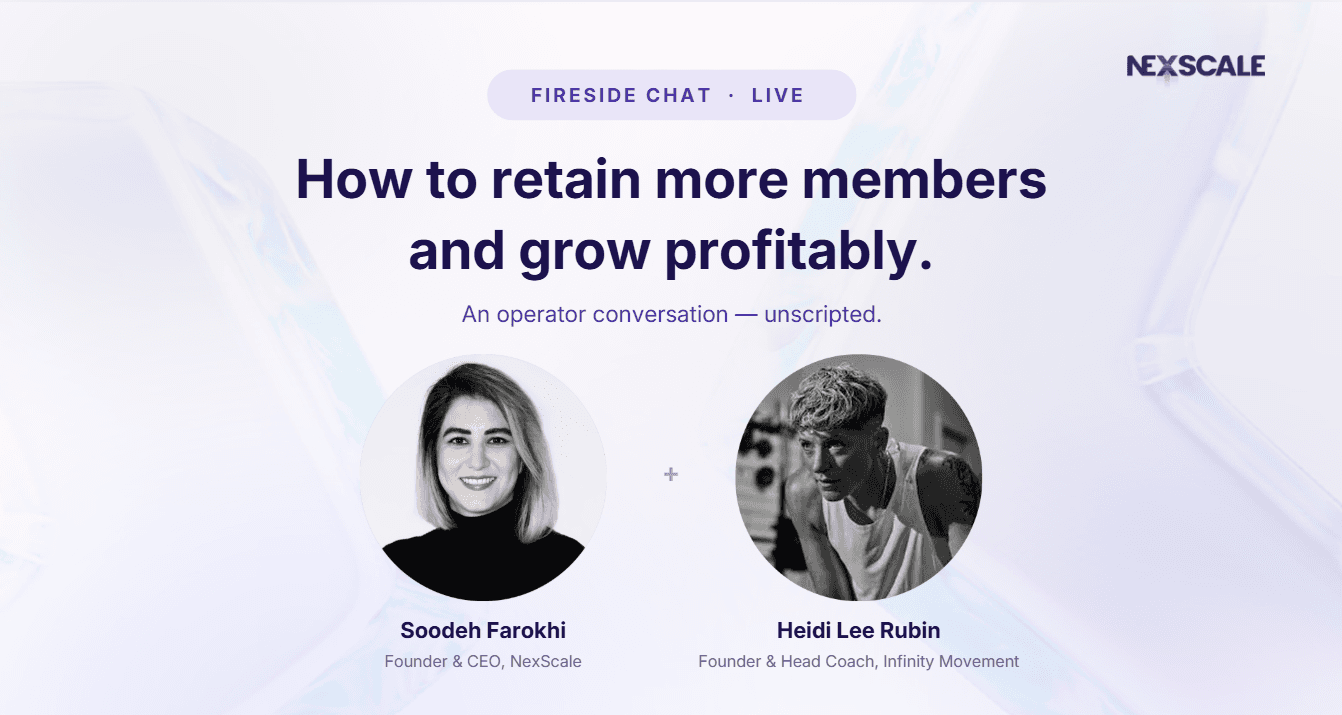
Part three: the fireside chat with Heidi Rubin
Heidi Lee Rubin has spent 25 years in the fitness industry, first as a coach and now as the founder of Infinity Movement, a strength and conditioning studio in Montreal with a reputation for being brave, inclusive and unusually community-driven. Infinity Movement was NexScale's first client and Heidi has been a Founding Operator since February. The conversation was unscripted, and it was the part of the session we heard about most afterward. (If you want the full story with the numbers, read How Infinity Movement runs member retention on NexScale.)
A studio built around the member, not the other way around
Heidi described Infinity Movement as "a response to how I felt in the fitness industry," an industry she loves and wanted to make better for clients and staff alike. Her guiding question is the reverse of the usual one: "How do we fit into your life?" rather than asking people to fit into the studio.
Some of the practices she shared were memorable on their own. The trial is 28 days, chosen intentionally because many members have a menstrual cycle of that length, and a one- or two-week trial might land in the wrong part of it. Monthly challenges come with stickers, glitter and a leaderboard. Pricing is a sliding scale with an anchor point, a sponsor tier and two supported tiers, reassessed after a few months. And an "energy exchange" lets members clean the space for a three-hour shift in return for classes. Heidi keeps hearing she has the cleanest gym around.
Why the human approach mattered
Heidi's non-negotiable was that anything sent to her members had to sound like Infinity Movement, not like software. That is why the relationship came first. As she put it in our case study: "To know that the business is founded and created by someone who has such a heart and cares so much, and truly wants to understand, helps me to feel comfortable." NexScale Chloe™ was tuned to Infinity Movement's voice during onboarding, and Heidi's verdict on the messages that go out today is short: "It does sound like me. It's pretty cool."
What Chloe does for the studio every day
Heidi's member experience manager and partner, Melanie, works with Chloe every day. Each morning the daily brief tells her who to celebrate, who to check in on and where to focus, and she uses it to connect with members before a small change in habits turns into anything bigger. Heidi's summary: "We really do appreciate knowing far in advance when people's habits start to shift."
The reporting that gave her back her time
The change Heidi called "a huge, huge game changer" was not what we expected: the reports. Heidi works with business consultants who need her numbers regularly, and pulling and validating those figures used to take hours, sometimes days. Now they arrive on the same day every week, ready to use. "Now I can quickly see which direction I need to make decisions in."
How much time approvals take
One question operators always ask is how much work it is to approve messages. Heidi's answer: as long as it takes to read one and click. "I'm not a very techy person, and Melanie is the same. We take it and it takes us no time."
The results, in her words
Between January and April 2026, Infinity Movement's active membership grew from 179 to 209, and monthly churn fell from 13.75% in the first half of 2025 to 2.57% in the first quarter of 2026. Heidi made other changes in the same period, including pricing and onboarding updates, so we do not claim those numbers for NexScale alone. What she does claim is this: "There is a clear return on investment. I see it. I feel it. The people that I'm working with see it."
On the day-to-day: "The reports have helped soothe my mind in a way that's hard for me to explain. I'm way less terrified on a day-to-day basis as a business owner." And on how it compares with the tools she has used before: "My own CRM has felt like it's sabotaged me, and this is the only one that's supported me in a way that makes me feel really, really human and cared for."
Her advice to other operators
Heidi closed with a coach's framing: "Things take the time that they take, just like learning how to squat, just like learning how to lift heavy. But if we start sooner, it takes less time to get there." She has tried several consulting and advisory programs over the years. This, she said, was the one that made her feel supported in a way that felt human. "I highly recommend giving it a shot. And call me. We'll chat."
Part four: what working with NexScale looks like
We finished with a short, practical answer to the question most people came with: what does it actually look like to work with NexScale?
NexScale sits on top of the CRM you already use. We are CRM-agnostic and we never ask you to replace anything. Getting started takes about ten minutes on our website, and from there onboarding is guided, with regular sessions with me through your first months. Your first retention audit of your member base arrives within days of connecting. Nothing goes out to a member without your approval, everything sounds like your studio, and you get a daily brief plus weekly and monthly executive summaries written for operators, not analysts.
On the questions that matter most: your data belongs to you, it is used only to act on your studio, and privacy is designed in from the start. And we are a Canadian company, with a Canadian team, and we price in Canadian dollars for Canadian businesses.
What comes next
We announced our Founding Operator Program summer cohort during the webinar, with a discounted rate for the first three months, weekly sessions directly with me, and a 100% satisfaction guarantee. That cohort has now closed, and onboarding sessions with the new operators are underway. If you would like to be considered for the next cohort, or you just want to talk through what retention looks like in your business right now, get started with NexScale or book a short discovery call.
Retention is where we started, but it is not where we stop. Our mission is to scale wellness and fitness businesses today to power human longevity tomorrow. The next capabilities we are building are around community building and longevity as a service that your studio can offer its members. If you were with us on August 26, you were part of the beginning of that.
Thank you to everyone who joined, to FitBizWeekly for the coverage, to the Fitness Industry Council of Canada for being in the room and supporting us, and most of all to Heidi for sharing her story so openly.
Related resources: Member Churn Prediction: How AI Sees Cancellations Six Weeks Early · Automated Member Follow-Ups That Don't Feel Automated · The Daily Brief: Know Your Business in Two Minutes Every Morning · The NexScale Founding Operator Program
About NexScale
NexScale™ is an AI Business Partner for wellness and fitness operators — retention intelligence layered on any CRM they already run, never replacing it. It finds the members slipping away weeks before they cancel, then it acts: a personalized message in the brand voice, sent with the operator's approval, every follow-up handled and reported back.
Interested in building a wellness & fitness business that your members return to? Get started with NexScale.
Meta description: Recap of NexScale's August 26 webinar on AI-powered member retention with Heidi Rubin of Infinity Movement: the cost of churn, the pre-cancellation timeline, what AI can and cannot do, and three questions to ask any vendor. Recording available on request.

