

Two years ago, for my fortieth birthday, I gave myself an unusual present. I left a comfortable executive career and started a company.
The reason goes back to a book I re-read every January. Chasing Daylight, by Eugene O'Kelly.
O'Kelly was CEO of KPMG in the United States. Twenty thousand employees, a calendar booked eighteen months out. At fifty-three he walked into a doctor's office with some numbness in his face and walked out with about a hundred days to live.
He did not chase a miracle. He sat down, like the executive he was, and planned the best hundred days of his life. He unwound his relationships one by one. He called them perfect moments, and he wrote that he had more of them in those few weeks than in the previous five years.
I read it every year so I can ask his question while it is still cheap to answer. If I had three months, what would I do? And then the harder one. Why am I waiting?
The version of that question with better maths
Here is what changes the calculation.
In longevity research there is an idea called escape velocity. Right now, for every year you stay alive and healthy, medical science hands back roughly three extra months of healthy life. Treatments improve. Diagnostics catch things earlier. Each year the ground moves slightly in your favour.
Escape velocity is the tipping point: the year science gives back more than the year you just spent.
Ray Kurzweil thinks we could reach it in the 2030s. You do not have to take the timeline literally. Take the direction.
Because the strategy it implies is simple. Longevity is not about adding years at the end. It is about staying healthy long enough for the science to compound.
Your only job is to still be in the game.
Which is mostly in your hands
Somewhere between seven and thirty percent of how we age is written in our genes. The rest, seventy percent or more, is lifestyle. Movement, sleep, food, connection. Micro-decisions made on ordinary days.
Peter Attia calls your final years the marginal decade. His point is uncomfortable and correct: you will live that decade with the body you are building right now. It is not built in that decade. It is built in this one.
So it all comes down to consistency. Showing up, week after week, for years.
And almost nobody stays consistent alone.
The place where those choices actually happen is your yoga studio. Your gym. Your Pilates class. Your run club. These businesses are the front line of human longevity, whether or not anyone calls them that.
Which is what makes the next part matter far more than it looks like it should.
The uncomfortable truth about the industry longevity depends on
About half of new members stop showing up within the first three to six months.
I spent two years sitting with more than two hundred wellness and fitness operators, and the reason turned out to be painfully human. Personal connection is what keeps people, and personal connection is the first thing that collapses as a business grows.
At forty members, the owner knows everyone. At six hundred, she cannot. Not because she stopped caring, but because there are only so many hours.
And by the time churn shows up in a report, it has already happened.
The business result is familiar: growth stalls, revenue leaks. The human result is the one I cannot stop thinking about. Every cancellation is someone who just lost their main engine of movement and community. Their longevity practice, gone quiet.
Nobody leaves suddenly
Here is the part that reorganised how I think about this.
A cancellation is the last event in a sequence, not the first.
Around eight weeks out, she books a little less. Five weeks out, she comes less. Two weeks out, she goes quiet. Then, at week zero, she cancels, and everyone is surprised.
It was never sudden. The research is precise: on average, a member stops showing up 2.31 months before they cancel.
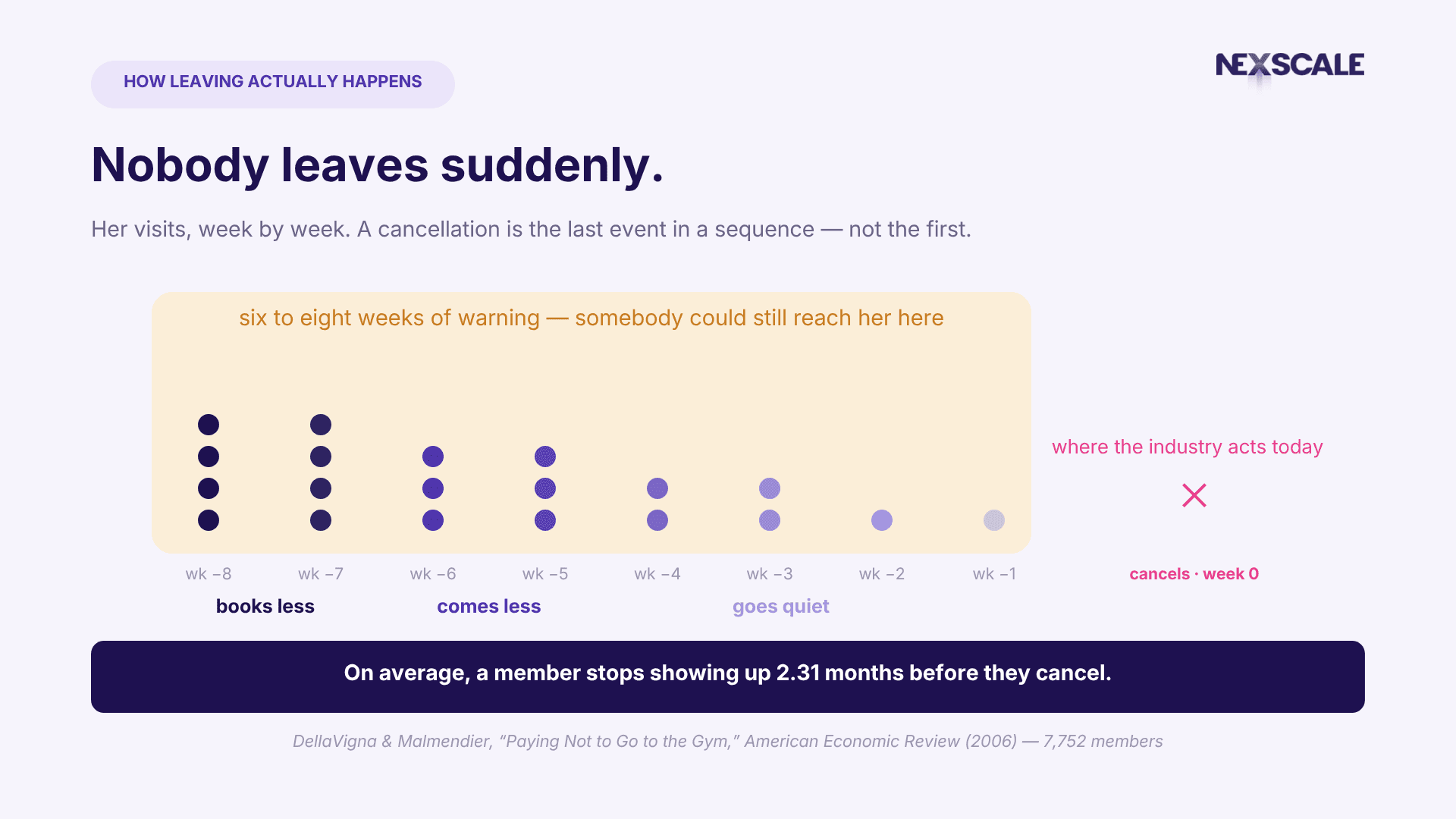
And that is exactly where our industry acts. At the cancel button. The one moment when nothing works, because the decision was made weeks ago.
Look instead at the window before it. Six to eight weeks of warning. Every member, every time. Somebody just has to be listening.
Why the discount never works
Ask people why they left and you get a tidy list. Thirty-two percent say they moved or changed jobs. Sixteen percent say money.
Ask researchers what actually happened and a different set surfaces. Expectations were not met. Momentum faded. Nobody had my back. It stopped fitting my life.
Notice what is missing: price.
We give a comfortable reason because the real one is awkward to say out loud. I stopped feeling like I belonged there, and nobody noticed.
We do not stay for a price. We stay because we belong. And belonging is not only good for the business. It is one of the strongest predictors of a long, healthy life that science knows.
Which is why these two messages perform so differently:
"We miss you! Here's 20% off your next month."
"Hi Priya, it's Jessy from Stay Up. You were in three times a week through March, and we've missed you. Everything OK? Your Tuesday 6am spot is still yours."
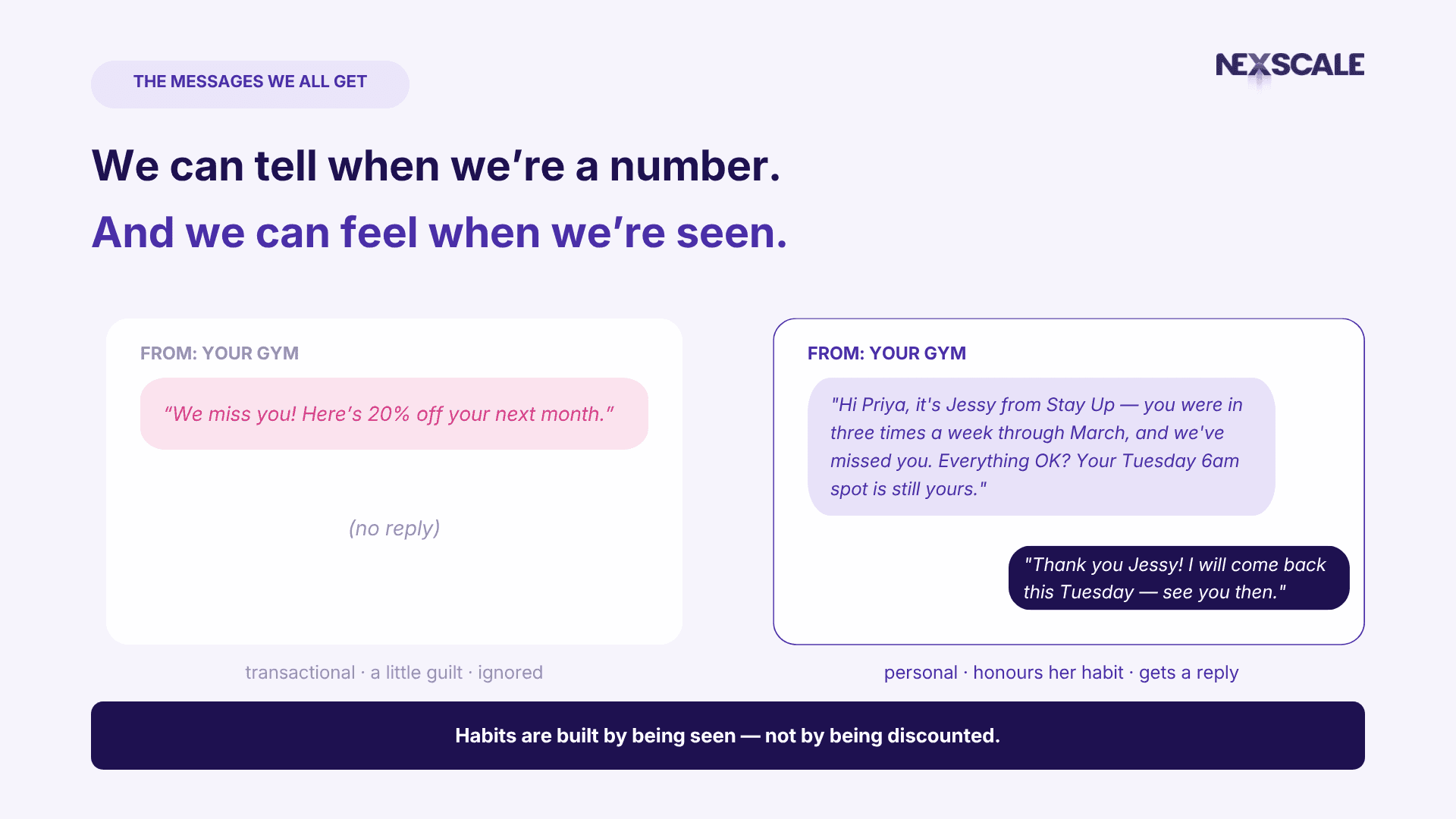
Same goal. Completely different feeling. Only one gets a reply.
Habits are built by being seen, not by being discounted.
So: retention is a health metric
When a studio keeps a member, the business gets stronger. But a human being also kept moving, kept showing up, kept belonging.
Multiply that across hundreds of members and thousands of studios and retention stops being a metric. It becomes longevity infrastructure.
Where AI belongs, and where it does not
The gap I described is not a caring problem. It is a memory problem. Memory is what breaks first when humans get busy, and memory is exactly what software is good at.
So the rule we build by is this:
AI does the noticing. Humans keep the relationship.
NexScale plugs into the software a studio already runs. Privacy first, it learns how each member normally shows up, notices when someone starts slipping weeks before they would cancel, and drafts the check-in message.
Then it stops. A person approves every message before it reaches a member.
That gate is not a limitation we are working to remove. It is the product. The AI carries the memory. The care stays human.
If you are building anything with AI right now, I would offer you the same rule. Let the machines watch the patterns. Keep the humans in the moments that matter. People can feel the difference, every time.
The front door to longevity
Here is the part I believe most.
For most people, longevity will not arrive through a clinic. It will arrive through a place they already go. After home and after work, the studio is the third place, and it is where habits are actually built, because somebody there notices when you stop coming.
That is not a claim about technology. It is a claim about where health is really made. And it is already true today. The operators doing this well are not waiting for anyone to invent a new category for them.
Not a clinic for the wealthy few. A community you are already part of.
That is the vision: expanding human longevity by scaling the businesses that already help people build health.
And it starts with something much smaller. Noticing the member who has gone quiet, while there is still time to say something.
Life isn't waiting. Neither should you.
Ready to see this on your own data? Get started with NexScale. Three-month introductory period, 100% satisfaction guarantee.
Soodeh Farokhi, PhD is the Founder and CEO of NexScale™. This piece began as her talk at Medium Day 2026.
Figures are drawn from published research and are illustrative of the pattern, not guarantees. Sources: Oliveira et al. (2021) · DellaVigna & Malmendier, American Economic Review (2006) · Dr. Paul Bedford, The Black Report (2014) · Peter Attia, Outlive (2023) · Ray Kurzweil, The Singularity Is Nearer (2024) · Eugene O'Kelly, Chasing Daylight.
